(877) 786-1789

contact@paylessautoshippingservices.com

How Car Size Affects Your Shipping Cost

Posted On : 06/27/2026

3 min(s) to read

how car size affects shipping cost

Two customers. Same route — New York to Florida. Same open carrier. Same week.

Customer A ships a Honda Civic. Pays $850.

Customer B ships a Ford F-250 with a lifted suspension. Pays $1,200.

The only difference? The vehicle. Size is one of the most significant — and most misunderstood — factors in auto transport pricing. Here’s exactly how it works.

Why Size Matters More Than Distance

Most people focus on distance when comparing quotes. But carriers think in terms of space, weight, and height — not miles.

An open carrier truck holds 8–10 vehicles, stacked on two levels. Every vehicle on that truck takes up a specific amount of deck space. Larger, taller, and heavier vehicles take up more space — sometimes blocking an entire second level — which means the carrier earns less revenue per truck.

To compensate, carriers charge more for larger vehicles. It’s not arbitrary — it’s straightforward economics. The less space your vehicle leaves for others, the more it costs to ship.

The rule of thumb: Every step up in vehicle size adds approximately $75–$150 to your base shipping cost on most routes. A full-size truck can cost $200–$400 more than a compact car on the same route.

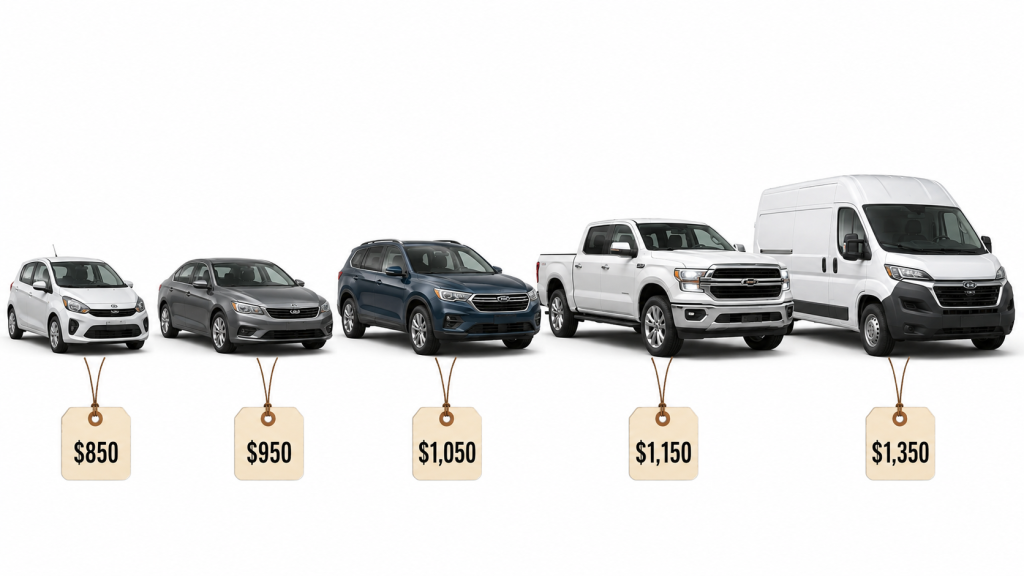
The Vehicle Size-to-Price Ladder

Here’s how vehicle size tiers map to price — from the cheapest to ship to the most expensive:

1
Compact Car Honda Civic, Toyota Corolla, Hyundai Elantra Base Rate
2
Standard Sedan Toyota Camry, Honda Accord, Nissan Altima +$50–$75
3
Mid-Size SUV Toyota RAV4, Honda CR-V, Ford Escape +$100–$150
4
Full-Size SUV Chevrolet Tahoe, Ford Expedition, GMC Yukon +$150–$250
5
Standard Pickup Truck Ford F-150, Chevy Silverado 1500, RAM 1500 +$150–$250
6
Heavy Duty Truck Ford F-250/F-350, RAM 2500/3500, Chevy Silverado 2500 +$200–$350
7
Cargo Van / Minivan Ford Transit, Mercedes Sprinter, Dodge Grand Caravan +$200–$400
8
Oversized / Modified Lifted trucks, extended vans, vehicles with added accessories +$300–$600

Tier Breakdown — What You'll Pay by Vehicle Type

Compact & Standard Sedans Cheapest to Ship

Small cars are the easiest to load, take up the least deck space, and can be stacked on both levels of an open carrier. Carriers love them — and that love shows up in your price.

If you drive a compact or standard sedan, you’re getting the best possible rate for your route. No surcharges, no size penalties.

Examples: Honda Civic, Toyota Corolla, Mazda3, VW Jetta, Hyundai Elantra, Toyota Camry, Honda Accord
Mid-Size & Full-Size SUVs Moderate Premium

SUVs are wider and taller than sedans. A mid-size SUV typically adds $100–$150 to a base sedan rate. A full-size SUV like a Tahoe or Yukon can add $150–$250.

Height is the key factor here. Taller vehicles can’t always fit on the upper deck of a carrier — forcing the carrier to load them on the lower deck where space is limited.

Mid-size: Toyota RAV4, Honda CR-V, Ford Escape, Jeep Cherokee  |  Full-size: Chevy Tahoe, Ford Expedition, GMC Yukon, Dodge Durango
Pickup Trucks Significant Premium

Pickup trucks are long. That’s the issue. A standard F-150 crew cab is over 19 feet long — nearly double the length of a compact car. That length takes up proportionally more deck space on the carrier.

Standard half-ton trucks (F-150, Silverado 1500) add $150–$250 to a base rate. Heavy duty trucks (F-250, F-350, RAM 2500) add $200–$350 due to both length and weight.

Half-ton: Ford F-150, Chevy Silverado 1500, RAM 1500, GMC Sierra 1500  |  Heavy duty: Ford F-250/F-350, RAM 2500/3500, Chevy 2500/3500
Vans & Cargo Vans Highest Standard Premium

Full-size cargo vans and passenger vans are both tall and long — the worst combination for carrier loading. They often can’t go on the upper deck at all due to height restrictions.

A Ford Transit or Mercedes Sprinter can add $200–$400 to a base rate. Extended-length versions add even more.

Examples: Ford Transit, Mercedes Sprinter, Ram ProMaster, Ford E-Series, GMC Savana, Chrysler Pacifica

Get an Accurate Quote for Your Exact Vehicle

Tell us your year, make, and model — we’ll give you the right price, not a generic estimate.

(877) 786-1789

contact@paylessautoshippingservices.com

Same Route, 5 Different Vehicles — Real Price Comparison

Here’s exactly what the same route looks like priced across five different vehicle types. Route: New York → Florida, open transport, standard conditions.

VehicleExample ModelEstimated Quotevs. Compact Car
Compact CarHonda Civic$800 – $950Base rate
Standard SedanToyota Camry$850 – $1,000+$50–$75
Mid-Size SUVFord Explorer$950 – $1,100+$150–$200
Full-Size Pickup TruckFord F-150 Crew Cab$1,000 – $1,200+$200–$300
Full-Size Cargo VanFord Transit LWB$1,100 – $1,400+$300–$450

Key takeaway: The difference between shipping a compact car and a full-size van on the same route can be $300–$450. That’s not a broker fee or a hidden charge — it’s purely the size of your vehicle.

The Height & Length Trap — Hidden Size Surcharges

Here’s what most people don’t realize: your vehicle’s stock size is just the starting point. Certain modifications and accessories can push your vehicle into a higher size tier — and a higher price — even if the base model would normally be cheaper to ship.

Lifted Suspension

A 4–6 inch lift kit adds significant height to your truck or SUV. Taller vehicles can’t go on the upper deck of a carrier — reducing available loading positions.

Extra cost: +$100 – $250
Roof Racks & Cargo Carriers

Roof-mounted racks, cargo boxes, or bike carriers add height. Most must be removed before shipping — if they can’t be removed, your vehicle is treated as oversized.

Extra cost: +$75 – $150 (or removal required)
Extended Cab / Long Bed Combos

A crew cab truck with a long bed can exceed 22 feet. That’s nearly impossible to fit on a standard carrier slot without blocking adjacent vehicles.

Extra cost: +$150 – $300
Oversized Tires / Wheel Spacers

Wide body kits, oversized off-road tires, and wheel spacers increase the width of your vehicle — affecting how carriers can position it on the deck.

Extra cost: +$75 – $200

Important: If you fail to disclose modifications at booking and the carrier discovers them at pickup, you’ll face an on-the-spot surcharge — or your shipment will be refused. Always disclose modifications upfront.

How to Accurately Describe Your Vehicle for the Right Quote

The most common reason quotes change between booking and pickup? The customer described their vehicle inaccurately — usually by forgetting to mention modifications or choosing the wrong trim level.

Here’s exactly what to tell your broker when requesting a quote:

Vehicle Information Checklist for Your Quote

Year, Make, Model, and Trim — e.g., “2022 Ford F-150 XLT SuperCrew” not just “Ford F-150”

Cab style — Regular, Extended, or Crew Cab (affects length significantly)

Bed length — Short bed (5.5ft), Standard (6.5ft), or Long bed (8ft)

Lift kit — Mention the lift height if your vehicle has been lifted

Roof accessories — Roof rack, cargo carrier, sunroof spoiler, or any roof-mounted equipment

Running condition — Does the vehicle start, roll, and brake under its own power?

Any oversized tires or body modifications — Wide tires, fender flares, side steps that extend beyond standard width

Pro tip: When in doubt, describe more — not less. A broker who knows exactly what they’re quoting will give you an accurate price. A broker who discovers surprises at pickup will charge you extra on the spot.

Get a Size-Accurate Quote for Your Vehicle

Tell us your exact vehicle details and we’ll give you the right price — no surprises at pickup, no hidden size fees.

(877) 786-1789

contact@paylessautoshippingservices.com

Related Articles

Get Your Free Auto Shipping Quote

Nationwide door-to-door auto transport • Fully insured • No hidden fees

Free Auto Shipping Cost Calculator

Free Local & Long-Distance Move Cost Estimator

Free Auto Shipping Cost Calculator